
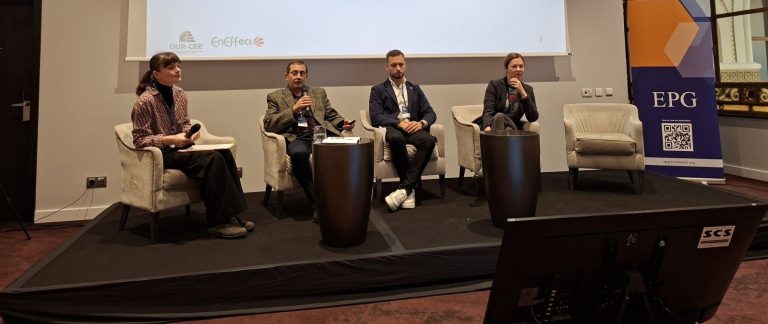
On 6 November 2026, Regional Energy Agency North (REA North) took part in Bucharest in the final conference of the OUR-CEE project (Overcoming Underperforming Renovations in Central and Eastern Europe), titled Bridging the Energy Performance Gap in Public Buildings Renovations: Findings and Recommendations for CEE. The conference brought together experts, public authorities and civil society representatives, and presented the project’s findings and recommendations for delivering high performing renovations of public buildings in Central and Eastern Europe.
Public buildings should be a leading first mover in the renovation of the building stock, yet after renovation they often fail to deliver the planned energy savings. The central topic of the conference was therefore the energy performance gap, the discrepancy between a building’s predicted energy use and its measured consumption following renovation, during operation. Research shows that actual consumption in public buildings is often up to 30% higher than predicted. When savings fall short of expectations, operating costs rise and renovation payback periods extend beyond those planned. This reduces the resources available for other public services and, at the scale of the entire building stock, slows emission reductions and makes it harder to achieve energy efficiency goals.
Drawing on findings from Romania, Bulgaria, Croatia and Poland, participants discussed the scale and underlying drivers of the gap, as well as practical solutions and policy recommendations to address it. The project results show that the causes cannot be traced to a single stage; instead, they accumulate throughout the renovation lifecycle. Among the most common are energy audits carried out as a mere formality, public procurement based solely on the lowest price, insufficient supervision of works, and a lack of post-renovation monitoring. The outcome of a renovation can therefore be influenced at four key stages: planning, financing, execution and monitoring.
REA North took part in three panel discussions. The panel Financing Mechanisms to Support High Performing Renovations examined how to align financing with the expected energy performance of renovations, and how grants, loans and private capital can contribute to better results. The panel Planning for High Performing Renovations in Public Buildings discussed how to take into account the way a building will actually be used after renovation when selecting and planning measures. The panel Tracking and Minimising Energy Performance Gap through Monitoring focused on using consumption measurements to verify whether the expected savings are being achieved and to identify underperformance early enough to take corrective action.
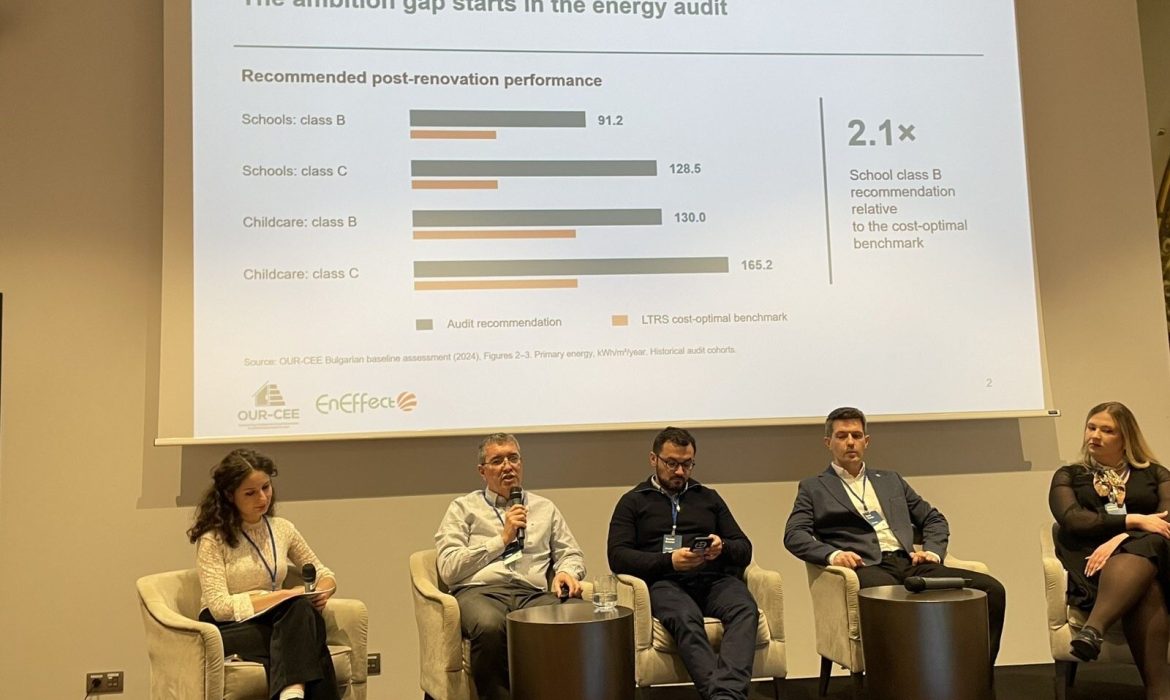
The project’s findings and recommendations were also discussed in the context of the recast Energy Performance of Buildings Directive (EPBD) and the National Building Renovation Plans (NBRP), whose development the OUR-CEE results are intended to support. Participants emphasised the importance of measured energy consumption data, both for verifying the results of completed renovations and for planning future investments in public buildings.
As part of the conference programme, REA North also presented the REDESIGN project in a presentation titled REDESIGN: Phasing Out Inefficient Buildings and Driving the Continuous Improvement of the Region’s Building Stock. REDESIGN builds on the results of OUR-CEE and focuses on the worst-performing public buildings and on preparing for the introduction of Minimum Energy Performance Standards (MEPS) required by the recast EPBD. The presentation therefore followed naturally from the discussion on the deep renovation of such buildings.
The conference was hosted by Energy Policy Group (EPG) from Romania, coordinator of the OUR-CEE project, which is implemented together with REA North, the Center for Energy Efficiency EnEffect from Bulgaria and the Association of Municipalities Polish Network “Energie Cités” (PNEC) from Poland. The project’s key findings are summarised in the publication Bridging the Energy Performance Gap, available on the project website our-cee.eu, including in Croatian.
OUR-CEE is financed through European Climate Initiative (EUKI).