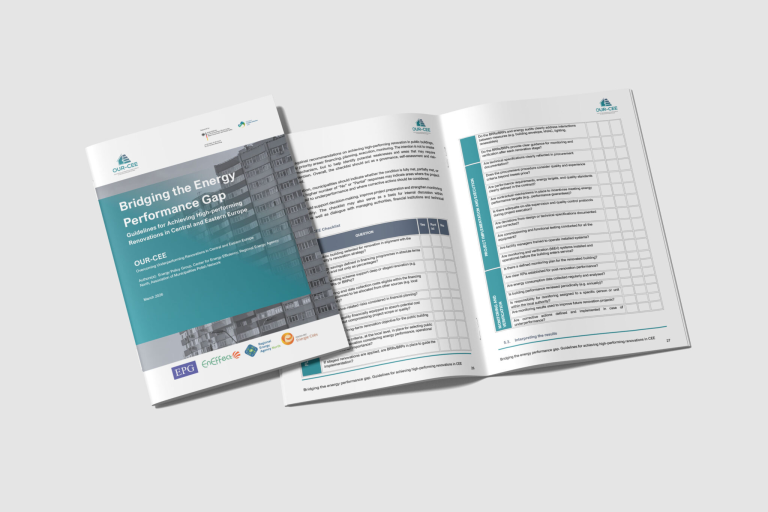
As part of the project Overcoming Underperforming Renovations in Central and Eastern Europe (OUR-CEE), partners from Croatia, Poland, Romania, and Bulgaria have developed a handbook aimed at improving the quality of energy renovations for public buildings. This collaboration has resulted in the creation of the Bridging the Energy Performance Gap: Guidelines for Achieving High-performing Renovations in Central and Eastern Europe (Handbook) which offers decision-makers a concrete set of measures to achieve high-performance results.
The central issue addressed by the Handbook is the so-called energy performance gap, a significant difference between the predicted (calculated) energy consumption and the actual consumption measured once the building is in use. Research indicates that actual consumption in public buildings is often up to 30% higher than planned.
The Handbook was developed based on previously conducted national baseline assessments of underperforming renovations in Bulgaria, Romania, Poland, and Croatia, stakeholder consultations, and activities carried out within OUR-CEE project.
Its goal is to provide decision-makers at national and local levels with a specific set of measures to address the problem of underperforming renovations. These measures are structured to cover all phases of the renovation process: Financing, Planning, Project Implementation, Operation and Monitoring through energy management systems.
The Handbook also includes a checklist with questions that can serve as a tool for local self-government units to plan activities and assess how current and future energy renovations of public buildings align with what is long-term considered high-quality renovation.
This document is designed to be key support at the local and national levels in transforming the public building stock into an energy-efficient and sustainable system.
The full document in English can be found at the following LINK, while the Croatian translation is available on the official website of REA North. OUR-CEE project is focused on increasing successful and high-quality energy renovations of public buildings in Central and Eastern European countries and is co-funded by the European Climate Initiative (EUKI).